

Artificial intelligence is revolutionising learning and teaching. The most exciting product of this revolution is probably the AI tutor. AI tutors are virtual learning companions that offer personalised instruction, instant feedback, and access at any time, making learning more convenient and relevant to students. With AI and the demand for intelligent learning growing at a rapid pace, AI tutors have become an integral part of learning today.
What Is an AI Tutor
An AI tutor is a smart computer program that employs artificial intelligence to assist students in comprehending subjects better. Unlike the conventional teacher, who must deal with numerous students simultaneously, an AI tutor offers personalised guidance that adjusts depending on the strengths and weaknesses of a student. It is able to provide practice exercises, clarify difficult concepts, indicate areas of emphasis, and maximise learning speed per learner.
AI tutors are applied to numerous topics and age groups, from preschool-aged children with mathematics and reading through to adults acquiring work skills or taking examinations.
Why AI Tutors Are So Popular
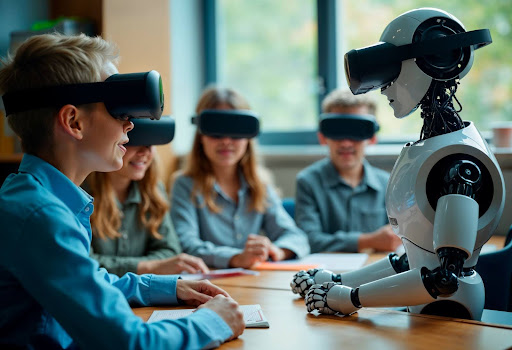 Image credit : Freepik
AI teachers are popular because they adapt to learning. They monitor the progress of a person and coordinate lessons with their learning speed and style. Such assistance keeps students on track and increases comprehension.
Another major advantage is that they are flexible. AI teachers are anywhere, anytime. Students can learn at midnight, over the weekend, or while travelling. They are thus particularly valuable to individuals who work or reside in distant places. AI teachers also reduce the burden on teachers by performing tasks such as marking quizzes or responding to routine questions.
In regions where quality teachers are needed, AI tutors compensate by providing superior learning assistance to more pupils.
Key Advantages of AI Tutors
The largest advantage of AI tutors is customisation. They are aware of individual students’ learning habits and adapt content accordingly. This makes the learners engaged and enthusiastic. Another strong feature is immediate feedback. Students don’t need to wait days to know whether they are going the right way or not. Instant replies remedy uncertainty and result in improved learning outcomes in an instant.
AI tutors also facilitate independent learning. They enable the students to learn at their own rate and revisit areas they struggle with. Such tools enable teachers to have a better time handling large classes by automating mundane activities, thus leaving time for valuable interaction with the learners.
In commerce, AI tutors can also be employed in employee training to assist workers in gaining skills economically through computer-automated guided courses.
How AI Tutors Assist Learning Management Systems
Learning Management Systems, or LMS platforms, are utilized by the majority of schools and companies today to provide online courses. Such platforms are compatible with AI tutors. AI tutors can assist with student tracking, recommend lessons based on the learner’s needs, and even forecast performance in the future based on data.
LMS systems in 2025 emphasize mobile-first, concise, targeted learning modes referred to as ‘microlearning’. AI-based tutors facilitate ease of access and understanding of such content. They are able to provide recommendations, track engagement, and engage learners with activities such as gamification or courses using virtual reality.
AI-based tutors also provide provisions such as automated assessment, interactive practice, and voice or chat-based help systems, thus making the learning process more holistic.
Issues in Using AI Tutors
There are a number of problems with using AI tutors. There are many advantages, but problems are data privacy. These systems gather a lot of information about users, and that must be secured. Schools and companies have to comply with regulations and put protective measures in place for personal data.
The other challenge is fairness. The AI systems need to be properly designed so that they are unbiased and produce varied responses for diverse groups. Too much reliance on AI can also be possible. Students require human intervention for emotional support, critical thinking, and social development.
Lastly, the AI tutors are required to be upgraded periodically. Because subjects change and learning styles change along with them, the systems are required to be upgraded to remain relevant and useful.
The Future of AI Tutors
Image credit : Freepik
AI teachers will become more central to education in the years to come. The more advanced the technology gets, the more sophisticated features these systems will provide, including voice dialogue, mood tracking, and even virtual reality settings. They will continue to become more affordable and mainstream, assisting those students who reside in distant regions or poor communities with access to quality learning materials.
In the future, AI teachers can also serve as career counsellors, assisting students in selecting a career or course of study by interest and aptitude. But as these technologies become more powerful, human teachers will still be needed. The optimal results will be achieved by combining AI assistance with human guidance.
Conclusion
AI tutors are revolutionising the education industry with their ability to make learning more adaptive, efficient, and personalised. They guide students step by step, providing intelligent feedback and instant assistance. Although there are some problems that have to be tackled, such as privacy and fairness, the potential of AI tutors cannot be overlooked. With schooling happening online, these technologies will be a major factor in enabling students to learn and realise their potential.